Crowns and veneers in Weybridge
Crowns and veneers both restore the look and strength of teeth, but they suit different problems. Here is how they differ, what each costs and how we help you choose.
- Fee
- From £980 to £1,250
- Google reviews
- 4.9

Crowns and veneers: what is the difference?
Crowns and veneers are both custom-made coverings for teeth. People often mention them in the same breath, yet they do different jobs. Choosing between them depends less on looks than on how healthy and strong the tooth underneath is.
A crown covers the whole visible tooth, from the biting edge down to the gum line. It holds a weakened tooth together. Crowns are usually advised for teeth that are broken, decayed, heavily filled or root-filled.
A veneer is a thin layer of tooth-coloured material bonded to the front surface of a tooth. It changes the colour, shape or apparent position of a tooth that is otherwise sound. Veneers are mainly a cosmetic treatment for front teeth that are discoloured, chipped, worn or slightly out of line.
Which might suit you?
As a rough guide, if the main concern is strength, a crown is more likely. If the tooth is strong and the concern is how it looks, a veneer may be enough. In practice many factors come into it:
- where the tooth sits in your mouth
- how much healthy tooth structure remains
- the size and age of any existing fillings
- the forces from your bite, including any grinding habit
- the health of your gums and the root beneath
Your dentist weighs all of these. The deciding question is always what will keep the tooth healthy and working for the long term. Treatment is subject to a consultation and assessment. Sometimes the answer is neither a crown nor a veneer.
Crowns and veneers at Post House Dental
A careful assessment
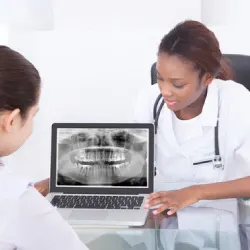
We start with an examination, x-rays and photographs. A digital scan of your teeth gives us an accurate 3D record of your bite. We look at the tooth under magnification. Our surgical microscopes show fine cracks, leaking fillings and early decay that are hard to see with the naked eye. The microscope's camera lets us show you these images, so you can see the reasons behind our advice.
If the tooth needs work before it can be restored, such as treatment of decay or a root canal, we explain that first. If your gums are inflamed, we may suggest treating them before any crown or veneer is made, because healthy gums give a better fit and appearance.
Crowns
For a crown, the tooth is numbed with local anaesthetic and shaped to make room for the new surface. We record its shape and fit a temporary crown while the final one is made. At a second visit we check the fit and bite, then fix the crown in place. We offer all-porcelain, porcelain bonded to metal and gold crowns. You can read more on our dental crowns page.
Veneers
Veneers usually need less of the tooth to be removed than a crown does, because they cover only the front. The shade and shape are planned with you before anything is made. Porcelain veneers are made in a laboratory and bonded on at a later visit. See our porcelain veneers page for more on the process.
In most cases veneers involve removing a thin layer of enamel that cannot grow back, so we only suggest them when the benefit is worth it. That is why we always discuss gentler options first.
Other options to consider
We favour treatment that keeps as much natural tooth as possible. Depending on what you need, alternatives include:
- Composite bonding, where tooth-coloured resin is added to the tooth with little or no drilling. It can close small gaps or rebuild chipped edges.
- An onlay, which covers only the weakened part of a back tooth rather than the whole of it.
- Teeth whitening, if the concern is colour alone and the teeth are otherwise healthy.
- Teeth straightening, if the teeth are sound but out of line.
Each has its own trade-offs in cost, durability and upkeep. We will set these out plainly so you can make a choice you are comfortable with.
How much do crowns and veneers cost?
At Post House Dental, a zirconia crown is £980, an E.max crown is £980 to £1,250 and veneers are from £1,350. The final fee depends on the material, the number of teeth and any treatment needed beforehand. We confirm it in a written treatment plan after your assessment. Nothing goes ahead until you have seen and agreed that plan. Our full price list is on the fees page.
We provide both NHS and private care. Veneers are cosmetic and are generally not available on the NHS. Whether a crown can be provided on the NHS depends on clinical need and on our availability at the time. Please ask us. Online booking is for private appointments only.
Recovery and aftercare
After a crown or veneer is fitted, the tooth may feel sensitive to cold for a few days. The new surface can also feel unfamiliar against your tongue at first. Most people stop noticing it within a week or two. If your bite feels uneven, contact us so we can adjust it.
Look after your crowns and veneers as you would your own teeth:
- Brush twice a day with a fluoride toothpaste.
- Clean between your teeth every day.
- Avoid biting hard objects such as ice, pens or nutshells.
- Wear a night guard if we advise one for grinding.
- Keep up regular check-ups and hygiene visits.
Crowns and veneers do not decay, but the tooth around and beneath them can. How long they last varies from person to person. It depends on your bite, your habits and how well the area is kept clean.
Why patients choose us
Post House Dental has looked after patients in Weybridge since 1978. We use surgical microscopes for precise preparation and digital x-rays for diagnosis. Our clinical approach is evidence-based and biomimetic, which means we aim to rebuild teeth in a way that respects their natural structure. Our team keeps up with postgraduate education. You will always receive a clear explanation and a written plan before you commit to anything.
Your treatment, step by step
-
1
Consultation and assessment
We examine your teeth, take x-rays and photographs and listen to what you would like to change.
-
2
Options and written plan
We explain whether a crown, a veneer or a gentler option suits each tooth. You receive a written plan with confirmed fees.
-
3
Preparation
The tooth is numbed and prepared under magnification. A temporary is fitted where needed.
-
4
Fitting
We check the fit, colour and bite before fixing the crown or veneer in place.
-
5
Review and maintenance
We check how things have settled and keep an eye on them at your routine visits.
Fees
| E.max crown | £980 to £1,250 |
|---|---|
| Veneers | From £1,350 |
Your exact fee depends on your assessment. We give you a written treatment plan with costs before any treatment starts. See all fees.
Questions patients ask
Should I have a crown or a veneer?
It depends mostly on the strength of the tooth. A crown covers the whole tooth and is usually advised when a tooth is broken, heavily filled or root-filled. A veneer covers only the front and suits a strong tooth where the concern is colour, shape or minor position. Sometimes bonding or an onlay is a better fit than either. We advise after examining the tooth.
How much do crowns and veneers cost?
At Post House Dental a zirconia crown is £980, an E.max crown is £980 to £1,250 and veneers are from £1,350. The fee depends on the material, how many teeth are treated and whether other work is needed first. After your consultation and assessment you will receive a written treatment plan with the confirmed fee. You can see all our prices on our fees page.
Can I have crowns or veneers on the NHS?
Veneers are cosmetic and are generally not provided on the NHS. A crown may be possible on the NHS when it is clinically necessary. Whether we can offer it depends on our NHS availability at the time, so we cannot promise it in advance. Please call the practice to ask. Online booking is for private appointments only.
Do crowns and veneers hurt?
The tooth is numbed before we prepare it, so you should feel no pain during treatment. You will notice pressure and vibration. Afterwards the tooth may be sensitive to cold for a few days. The new surface can also feel unfamiliar. Most patients find this settles quickly. If you feel nervous about dental work, let us know so we can plan around it.
How long do crowns and veneers last?
It varies from person to person. Your bite and any grinding habit make a difference. So do your diet and how well you clean around the edges where the crown or veneer meets the tooth. Regular check-ups let us spot wear or decay early, when it is easier to fix. We will talk through what affects your own teeth at your assessment.